
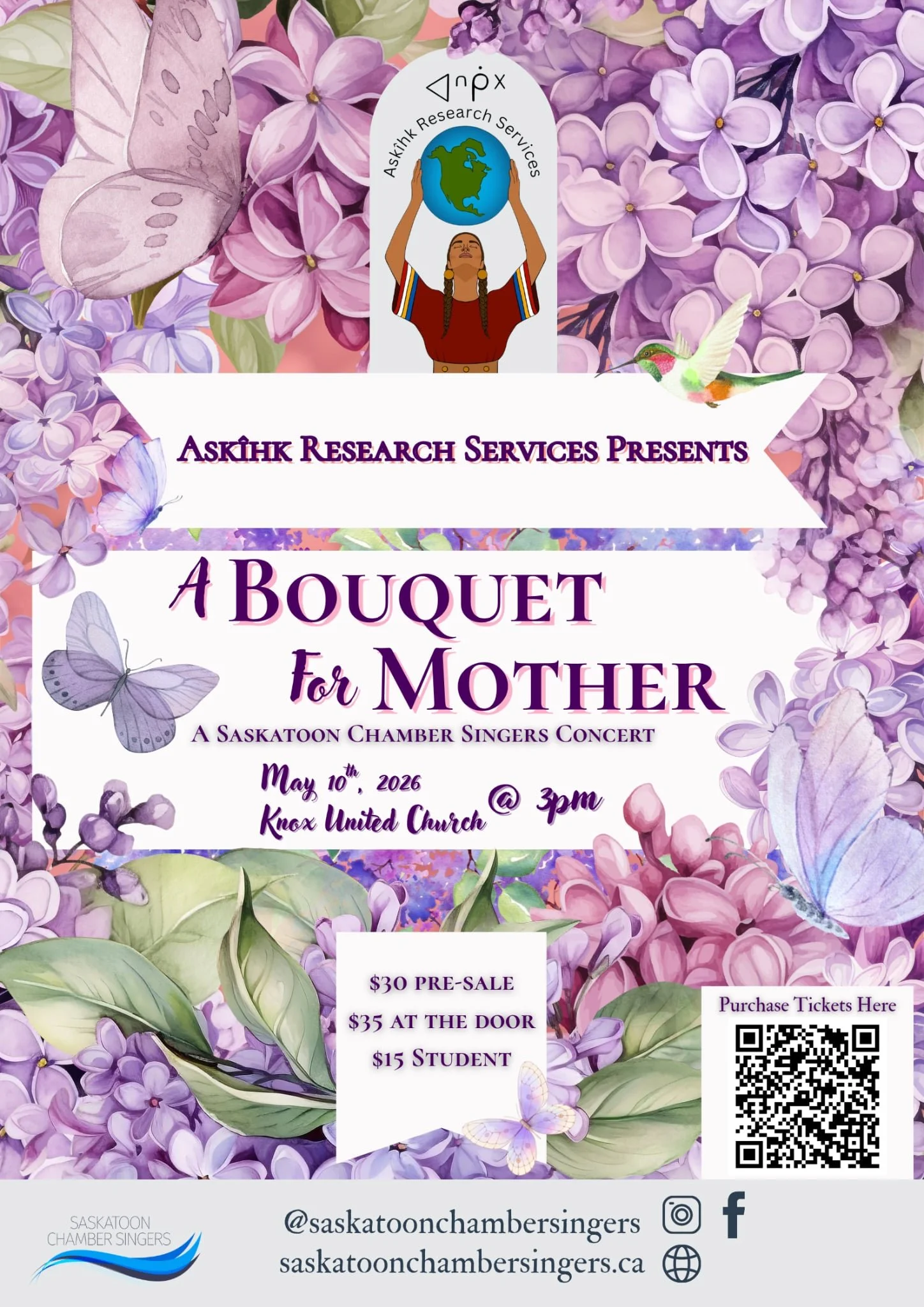
askîhk Research Services presents
A Bouquet for Mother
Joined by Janet Wilson (organ) and Scott McKnight (cello)
Knox United Church
May 10th, 2026 | 3:00pm
$35 – General at the door
$15 – Students
Program Notes
Mother’s Day is a celebration honouring the mother of the family or mother figure, as well as motherhood, maternal bonds, and the influence of mothers in society. It is celebrated on different days in many parts of the world (over 40 counties), but in Canada it is always the second Sunday in May. Mother’s Day was first introduced and celebrated in the early 1900s, often with religious overtones that have now been replaced by a sense of commercialism. In Canada, it is a day in the year we take to honour our mothers and all that they have done for us, for family, and beyond. It is interesting to note that “mother’s” is singular, as opposed to “mothers”, which was deliberate as it offered each person and each family a chance to reference its own mother.
This concert is offered as a bouquet to all mothers, and as such, it features pieces that speak about flowers, daffodils in particular, but lilacs, roses, evening primroses and sunflowers also get to raise their heads. There are also pieces about love, the beauty of nature, and the joy of singing.
Also, in this concert are two instrumental solos. Scott McKnight on cello (with Connor Elias on the piano) will perform Antonin Dvořák’s Songs My Mother Taught Me. Connor Elias will play a piece by Franz Liszt entitled Sonetto 104 del Petracha.
James Hawn, Artistic Director
-
The concert opens and closes with I Have Had Singing which paraphrases lines taken from Ronald Blythe’s Akenfield, a Portrait of an English Village. Blythe travelled around Suffolk interviewing famers, plowmen, blacksmiths – people whose stories dated back to the early 20th century. One gentleman, given the name Fred Mitchell, was an 85-year-old horseman who told his story of working a bleak, unfertile land in a life filled with little joy. In the middle of his story, he stopped and said,
“But there was always singing; the boys in the fields, the chapels were full of singing. I have had pleasure enough; I have had singing.Steven Sametz’s version was written for the Berkshire Choral Festival and speaks to amateur and professional musicians alike about the simple love of singing and the lasting joy it can bring. There is a wonderful harmonic feel to this piece with a wide vocal range that offers many tonal surprises along the way with lots of room for rubato. Ron Jeffers’ version is much more straight forward although there are many similarities with Sametz’s. Jeffers has several sections that feature the tenors and the basses although overall the piece has all four voices singing together.
-
Saskatchewan composer David K. MacIntyre composed a choral suite entitled Love In Public which set to music eleven sonnets written by Elizabeth Barrett Browning. The last sonnet in the suite is #44, Beloved, Thou Hast Brought Me Many Flowers. For the most part the voices enter one after the other repeating the same vocal line, almost as if they were having a conversation with each other. The sopranos begin, followed by the altos, then the tenors, and finally the basses. There are only two sections in the piece where the voices all sing the same words at the same time.
-
All Things Bright and Beautiful is vintage John Rutter – a beautiful melody, popular words, and a flowing accompaniment. Individual sections present the catchy and rhythmic theme and then are joined by the other voices to create infectious harmonies. Exuberant throughout, the piece does end quietly.
-
In 1950, Benjamin Britten composed Five Flower Songs, Op. 47 to texts of English poets who had all written about flowers. To Daffodils is marked allegro impetuoso and is set to a Robert Herrick text which is a metaphor of life passing. Often Britten has the sopranos and basses singing the outer parts with the altos and tenors singing together within those boundaries. The second section has the three upper voices singing very softly while the basses keep repeating the phrase “fair daffodils” to the thematic phrase heard at the opening. The Evening Primrose (poet John Clare), on the other hand, is tranquil and reflective. The evening primrose only blooms in darkness and so Britten depicts a nightscape with the music turning to slumber. The homophonic sections alternate with sections where the theme is introduced and then passed from voice to voice, often stretching the bounds of rhythm.
-
Mother is a very apropos piece for this concert. It was composed in 2022 by Canadian composer Stephanie Martin to a text written by her sister, Cori. It tells of the effect that mothers have on their children (in this case daughters) and how the mother’s body feeds them, provides them with teaching and how her blood flows through them like a river that eventually brought them to themselves. Martin often presents a theme which is then passed around to the other voices, much like a dialogue until all four voices come together. There is a flowing piano accompaniment throughout but the piece ends with seven bars sung a cappella.
-
In 1950, Benjamin Britten composed Five Flower Songs, Op. 47 to texts of English poets who had all written about flowers. To Daffodilsis marked allegro impetuoso and is set to a Robert Herrick text which is a metaphor of life passing. Often Britten has the sopranos and basses singing the outer parts with the altos and tenors singing together within those boundaries. The second section has the three upper voices singing very softly while the basses keep repeating the phrase “fair daffodils” to the thematic phrase heard at the opening. The Evening Primrose (poet John Clare), on the other hand, is tranquil and reflective. The evening primrose only blooms in darkness and so Britten depicts a nightscape with the music turning to slumber. The homophonic sections alternate with sections where the theme is introduced and then passed from voice to voice, often stretching the bounds of rhythm.
-
Daffodils is another piece by a Canadian composer – E.K.R. Hammell. He has taken Wordsworth’s poem I Wandered Lonely as a Cloud as his text. It begins with a piano introduction followed by what I call “a good tune” sung by the sopranos and altos who are then joined by the rest of the choir. The second section is sung by the tenors and basses who are then joined by the other two voices. There is a lyrical piano accompaniment throughout. This composition is meant to capture the pure, innocent feeling of contentedness, wonder, and bliss when recalling a special moment in one’s life.
-
Janet Wilson, organ
Gabriel Fauré was only nineteen when he composed Cantique de Jean Racine, Op. 11. Verbe égal au Très-Haut is a French paraphrase by Jean Racine of the Latin hymn from the breviary for matins Consors paterni luminis. The music is in D-flat major. The voices enter one after the other, beginning with the lowest, each presenting half a line of text, while the lower voices accompany in homophony. The second stanza is separated from the first by a short interlude similar to the introduction, while the third and fourth stanzas follow immediately in the way of a reprise. Zachary Gates notes in a paper that
“the long sweeping melodies and strong melodic and harmonic appoggiaturas are a testament to the Romantic side of the piece, but there is a definite contemporary tint to what he’s writing, hidden in every minute and well-justified atonal note choices in the harmonic structure and melody.”This piece foreshadows much of what will appear in his later Requiem.
-
Scott McKnight, cello
Elaine Hagenberg has a special talent for composing lyrical pieces with sweeping melodies that so beautifully convey the text. O Love is no exception. The text is an old familiar hymn by George Mattheson, O Love That Wilt Not Let Me Go. When Mattheson was blinded at age nineteen, his fiancé called off their engagement and his sister cared for him as he endured new challenges. Years later, on the eve of his sister’s wedding, he faced the painful reminder of his own heartache and loss as he penned the words to this hymn. Given a fresh melody, this setting for SATB choir, piano, and cello uses hopeful ascending lines representing renewed faith. Though lingering dissonances remind us of a past heartache, the beautiful promise remains--“morn shall tearless be.”
-
American composer David Dickau set to music four poems that he had long admired. These poems deal with the diverse aspects of living and longing and form a set called Of Life and Love. We will perform two of the four. in time of daffodils is a poem by e e cummings which describes the natural way in which flowers go about being as they were intended. The poet challenges the listener to find that same genuine quality and thus “forgetting me, remember me.” Each line of the poem contains a short “aha” moment at the end of each phrase. The music pivots to a new key at each of these places, emphasizing the new awareness depicted in the text, and is sung a cappella. The final piece in the set is set to Thomas Campion’s poem, Come, O Come, My Life’s Delight. This poem returns to the theme of anticipating the meeting of one’s beloved. The music juxtaposes major and minor keys to underscore the conflicting feelings of the poet as he awaits the reunion of his lover. There is a gentle feel of one to the bar throughout the piece.
-
American composer David Dickau set to music four poems that he had long admired. These poems deal with the diverse aspects of living and longing and form a set called Of Life and Love. We will perform two of the four. in time of daffodils is a poem by e e cummings which describes the natural way in which flowers go about being as they were intended. The poet challenges the listener to find that same genuine quality and thus “forgetting me, remember me.” Each line of the poem contains a short “aha” moment at the end of each phrase. The music pivots to a new key at each of these places, emphasizing the new awareness depicted in the text, and is sung a cappella. The final piece in the set is set to Thomas Campion’s poem, Come, O Come, My Life’s Delight. This poem returns to the theme of anticipating the meeting of one’s beloved. The music juxtaposes major and minor keys to underscore the conflicting feelings of the poet as he awaits the reunion of his lover. There is a gentle feel of one to the bar throughout the piece.
-
Larry Nickel is a prolific Canadian composer and arranger. In this concert we feature his arrangement of the Canadian folk song A la claire fontaine. This song may have appeared as early 1604 when the first French settlement was established in Quebec. A clear fountain, a rose, and heartbreak! Nickel gives the pentatonic melody evocative harmonization with something different for each stanza, some accompanied and some a cappella. This piece was premiered at the United Nations in Geneva.
-
C. S. Lewis was a great philosopher and writer who challenged many with his beliefs. Although he is buried in Headington Quarry, England, a special service was held on November 22, 2013 in Westminster Abbey where, fifty years after his death, a memorial was dedicated to him in Poets’ Corner. Paul Mealor, a Welsh composer, was commissioned to set Lewis’ poem Love’s as Warm as Tears to music for the occasion. Lewis asks us to recall the love that never ends, despite the hardships and misfortunes that may befall us. Mealor’s composition is marked adagio molto rubato and moves along at a steady, solemn speed except for nine bars in the middle which go double speed. There are sections that require the full volume of the choir and then there are sections where a gentle pianissimo is required. The text is brilliant. The verses begin
“Love’s as warm as tears, love is tears”,
“Love’s as fierce as fire, love is fire”,
“Love’s as fresh as spring, Love is spring”,
“Love’s as hard as nail, Love is nails.”Stanza three is for solo male voice sung over a very low drone from the basses on the syllable “ah.”
-
Scott McKnight, cello
Jacob Narverud’sSunflower is set to William Blake’s poem of the same name. It is composed for SATB choir and cello. The cello represents the sunflower and symbolizes humans bound to earth but pining for immortality. This setting “brims with text painting, delicious dissonances, and suspended harmonies.” The words “Sunflower, weary of time” are often repeated and each time it is as if a sigh is being released. There is dense harmonization throughout where the chorus is often singing in triplets and with chords of eight notes.
-
Ave Maris Stella (Hail, Star of the Sea) is a vesper hymn to Mary, mother of mothers, to act as a guiding star for seafarers and to intercede as a protector for those who travel or seek their livelihoods on the sea. Edvard Grieg takes four verses of this 9th-century hymn and pairs them, so that the third and fourth verses are set to the same music as the first two. Grieg’s harmonizations are rich and homophonic. The tenors and basses have two bars to themselves, but for the rest of the piece all four voices sing together, ending with a final “amen.” Grieg’s dynamics range from pianissimo to fortissimo.
-
Night Shall Be Filled With Music is a Longfellow poem (reminiscent of a text from Ecclesiastes 3) set to music by Larry Nickel. The piece has a contemporary feel and makes use of vocalizations on the syllable “do.” It is a song for hope with long lines in “sweet spot vocal registers.” Nickel creates a piece of music that needs to be sung with a full warm sound. We are reminded that the cares of the day “fold their tents and silently steal away.”
-
The concert opens and closes with I Have Had Singing which paraphrases lines taken from Ronald Blythe’s Akenfield, a Portrait of an English Village. Blythe travelled around Suffolk interviewing famers, plowmen, blacksmiths – people whose stories dated back to the early 20th century. One gentleman, given the name Fred Mitchell, was an 85-year-old horseman who told his story of working a bleak, unfertile land in a life filled with little joy. In the middle of his story, he stopped and said,
“But there was always singing; the boys in the fields, the chapels were full of singing. I have had pleasure enough; I have had singing.Steven Sametz’s version was written for the Berkshire Choral Festival and speaks to amateur and professional musicians alike about the simple love of singing and the lasting joy it can bring. There is a wonderful harmonic feel to this piece with a wide vocal range that offers many tonal surprises along the way with lots of room for rubato. Ron Jeffers’ version is much more straight forward although there are many similarities with Sametz’s. Jeffers has several sections that feature the tenors and the basses although overall the piece has all four voices singing together.
Text and Translations
Steven Sametz (b. 1954): I Have Had Singing
Text by Ronald Blythe (1922-2023) from Akenfield, Portrait of an English Village
The singing.
There was so much singing then,
And this was my pleasure too.
We all sang,
The chapels were full of singing, always singing.
Here I lie.
I have had pleasure enough,
I have had singing.
David K. MacIntyre (b. 1952): Beloved, Thou Hast Brought Me Many Flowers
Text by Elizabeth Barret Browning (1806-1861)
Belovèd, thou hast brought me many flowers
Plucked in the garden, all the summer through,
And winter, and it seemed as if they grew
In this close room, nor missed the sun and showers.
So, in the like name of that love of ours,
Take back these thoughts which here unfolded too,
And which on warm and cold days I withdrew
From my heart’s ground. Indeed, those beds and bowers
Be overgrown with bitter weeds and rue,
And wait thy weeding; yet here’s eglantine,
Here’s ivy!—take them, as I used to do
Thy flowers, and keep them where they shall not pine.
Instruct thine eyes to keep their colours true,
And tell thy soul, their roots are left in mine.
John Rutter (b. 1945): All Things Bright and Beautiful
Text by Mrs. C.F. Alexander (1823-1893)
All things bright and beautiful,
All creatures great and small,
All things wise and wonderful,
The Lord God made them all.
Each little flower that opens,
Each little bird that sings,
He made their glowing colors,
He made their tiny wings.
The rich man in his castle,
The poor man at his gate,
God made them high and lowly,
And ordered their estate.
The purple headed mountain,
The river running by,
The sunset and the morning,
That brightens up the sky;−
The cold wind in the winter,
The pleasant summer sun,
The ripe fruits in the garden,−
He made them every one.
The tall trees in the Greenwood,
The meadows where we play,
The rushes by the water,
We gather every day;−
He gave us eyes to see them,
And lips that we might tell
How great is God Almighty,
Who hath made all things well.
Benjamin Britten (1913-1976): To Daffodils (from Five Flower Songs)
Text by Robert Herrick (1591-1674)
Fair Daffodils, we weep to see
You haste away so soon;
As yet the early-rising sun
Has not attain'd his noon.
Stay, stay,
Until the hasting day
Has run
But to the even-song;
And, having pray'd together, we
Will go with you along.
We have short time to stay, as you,
We have as short a spring;
As quick a growth to meet decay,
As you, or anything.
We die
As your hours do, and dry
Away,
Like to the summer's rain;
Or as the pearls of morning's dew,
Ne'er to be found again.
Stephanie Martin (b. 1962): Mother
Text by Cori Martin (1959-2023)
Daughter of three mothers
mother of two daughters,
her body bore, and fed us.
We feasted on her teaching.
Her blood was in us beating,
flowing like a river that
brought us to ourselves.
Benjamin Britten (1913-1976): The Evening Primrose (from Five Flower Songs)
Text by John Clare (1793-1864)
When once the sun sinks in the west
And dewdrops pearl the evening's breast;
Almost as pale as moonbeams are
Or its companionable star
The evening primrose opes anew
Its delicate blossoms to the dew;
And, hermit-like, shunning the light
Wastes its fair bloom upon the night
Who, blindfold to its fond caresses
Knows not the beauty it possesses;
Thus it blooms on while night is by;
When day looks out with open eye
Bashed at the gaze it cannot shun
It faints and withers and is gone.
E.K.R. Hammell (b. 1993): Daffodils
Text by William Wordsworth (1770-1850)
I wandered lonely as a cloud
That floats on high o'er vales and hills,
When all at once I saw a crowd,
A host, of golden daffodils;
Beside the lake, beneath the trees,
Fluttering and dancing in the breeze.
Continuous as the stars that shine
And twinkle on the milky way,
They stretched in never-ending line
Along the margin of a bay:
Ten thousand saw I at a glance,
Tossing their heads in sprightly dance.
The waves beside them danced; but they
Out-did the sparkling waves in glee:
A poet could not but be gay,
In such a jocund company:
I gazed—and gazed—but little thought
What wealth the show to me had brought:
For oft, when on my couch I lie
In vacant or in pensive mood,
They flash upon that inward eye
Which is the bliss of solitude;
And then my heart with pleasure fills,
And dances with the daffodils.
Gabriel Fauré (1845-1904): Cantique de Jean Racine
Text by Jean Racine (1639-1699)
French Text:
Verbe égal au Très-Haut, notre unique espérance,
Jour éternel de la terre et des cieux ;
De la paisible nuit nous rompons le silence,
Divin Sauveur, jette sur nous les yeux !
Répands sur nous le feu de ta grâce puissante,
Que tout l'enfer fuie au son de ta voix ;
Dissipe le sommeil d'une âme languissante,
Qui la conduit à l'oubli de tes lois !
Ô Christ, sois favorable à ce peuple fidèle
Pour te bénir maintenant rassemblé.
Reçois les chants qu'il offre à ta gloire immortelle,
Et de tes dons qu'il retourne comblé!
English Translation:
Word equal to the Very High one, our sole hope
Eternal of both the Earth and the Heavens
Of this peaceful night, we break the silence
Divine Saviour, cast your gaze down on us!
Spread on us the fire of your mighty grace
So all of Hell flees upon hearing your voice
Dissipate the sleep of a yearning soul
Which leads us to forget your laws!
Oh Christ, be favourable to this faithful people
Now gathered to bless you
Welcome the hymns they offer to your immortal glory
And may they come back fulfilled!
Elaine Hagenberg (b. 1979): O Love
Text by George Matheson (1842-1906)
O Love that will not let me go,
I rest my weary soul in thee;
I give thee back the life I owe,
That in thine ocean depths its flow
May richer, fuller be.
O Light that foll’west all my way,
I yield my flick’ring torch to thee;
My heart restores its borrowed ray,
That in thy sunshine’s blaze its day
May brighter, fairer be.
O Joy that seekest me through pain,
I cannot close my heart to thee;
I trace the rainbow through the rain,
And feel the promise is not vain,
That morn shall tearless be.
O Cross that liftest up my head,
I dare not ask to fly from thee;
I lay in dust life’s glory dead,
And from the ground there blossoms red
Life that shall endless be.
David Dickau (b. 1953): in time of daffodils (from Of Life and Love)
Text by e e cummings (1894-1962)
in time of daffodils (who know
the goal of living is to grow)
forgetting why, remember how
in time of lilacs who proclaim
the aim of waking is to dream,
remember so (forgetting seem)
in time of roses (who amaze
our now and here with paradise)
forgetting if, remember yes
in time of all sweet things beyond
whatever mind may comprehend,
remember seek (forgetting find)
and in a mystery to be
(when time from time shall set us free)
forgetting me, remember me
David Dickau (b. 1953): Come, O Come My Hearts Delight (from Of Life and Love)
Text by Thomas Campion (1567-1620)
Come, O come, my life’s delight!
Let me not in languor pine:
Love loves no delay, thy sight
The more enjoyed, the more divine.
O come, and take from me
The pain of being deprived of thee.
Thou all sweetness dost enclose,
Like a little world of bliss:
Beauty guards thy looks: the rose
In them pure and eternal is.
Come then! and make thy flight
As swift to me as heavenly light!
Larry Nickel (b. 1952): A la claire fontaine
French Text:
À la claire fontaine
M’en allant promener
J’ai trouvé l’eau si belle
Que je m’y suis baigné.
Il y a longtemps que je t’aime
Jamais je ne t’oublierai.
Sous les feuilles d’un chêne
Je me suis fait sécher
Sur la plus haute branche
Un rossignol chantait.
Chante rossignol, chante
Toi qui as le cœur gai
Tu as le cœur a rire
Moi, je l’ai à pleurer.
J’ai perdu mon maitresse
Sans l’avoir mérité
Pour un bouquet de roses
Que je lui refusai.
Je voudrais que la rose
Fût encore au rosier
Et que ma douce amie
Fût encore à m’aimer.
English Translation:
By the clear fountain,
As I was strolling by
I found the water so nice
That I stopped there to bathe
I have loved you for a long time
I will never forget you.
Under an oak tree
I dried myself
On its highest branch
A nightingale was singing
Sing, Nightingale, sing
You with your carefree heart
Your heart feels like laughing
Mine feels like weeping
I have lost my beloved
Without just cause
Over a bouquet of roses
That I refused to give her.
I wanted the rose
To stay on the rosebush
And for my sweet love
To still love me.
Paul Mealor (b. 1975): Love’s as warm as tears
Text by C.S. Lewis (1898-1963)
Love’s as warm as tears,
Love is tears:
Pressure within the brain,
Tension at the throat,
Deluge, weeks of rain,
Haystacks afloat,
Featureless seas between
Hedges, where once was green.
Love’s as fierce as fire,
Love is fire:
All sorts—infernal heat
Clinkered with greed and pride,
Lyric desire, sharp-sweet,
Laughing, even when denied,
And that empyreal flame
Whence all loves came.
Love’s as fresh as spring,
Love is spring:
Bird-song hung in the air,
Cool smells in a wood,
Whispering ‘Dare! Dare!’
To sap, to blood,
Telling ‘Ease, safety, rest,
Are good; not best.’
Love’s as hard as nails,
Love is nails:
Blunt, thick, hammered through
The medial nerves of One
Who, having made us, knew
The thing He had done,
Seeing (with all that is)
Our cross, and His.
Jacob Narverud (b. 1986): Sunflower
Text by William Blake (1757–1827)
Ah! sunflower, weary of time,
Who countest the steps of the sun,
Seeking after that sweet golden clime
Where the traveller’s journey is done;
Where the youth pined away with desire,
And the pale virgin shrouded in snow,
Arise from their graves and aspire;
Where my sunflower wishes to go.
Edvard Grieg (1843-1970): Ave maris Stella
Latin Text:
Ave maris stella,
Dei Mater alma,
Atque semper virgo,
Felix coeli porta.
Sumens illud Ave
Gabrielis ore,
Funda nos in pace,
Mutans Evae nomen.
Solve vincla reis,
Profer lumen caecis,
Mala nostra pelle,
Bona cuncta posce.
Monstra te esse matrem.
Sumat per te preces,
Qui pro nobis natus,
Tulit esse tuus.
Virgo singularis,
Inter omnes mitis,
Nos culpis solutos,
Mites fac et castos.
Vitam praesta puram,
Iter para tutum,
Ut videntes Jesum,
Semper collaetemur.
Sit laus Deo Patri,
Summo Christo decus,
Spiritui Sancto,
Tribus honor unus.
Amen.
English Translation:
Hail, o star of the ocean,
God’s own Mother blest,
Ever sinless Virgin,
Gate of heav’nly rest.
Taking that sweet Ave,
Which from Gabriel came,
Peace confirm within us,
Changing Eve’s name.
Break the sinners’ fetters,
Make our blindness day,
Chase all evils from us,
For all blessings pray.
Show thyself a Mother,
May the Word divine
Born for us thine Infant
Hear our prayers through thine.
Virgin all excelling,
Mildest of the mild,
Free from guilt preserve us
Meek and undefiled.
Keep our life all spotless,
Make our way secure
Till we find in Jesus,
Joy for evermore.
Praise to God the Father,
Honor to the Son,
In the Holy Spirit,
Be the glory one.
Amen.
Larry Nickel (b. 1952): Night Shall Be Filled With Music
Text by Henry Wadsworth Longfellow (1807-1882)
Welcome music lovers everywhere.
We welcome you with one voice,
There’s a time to rend, a time to mend;
Now is the time for peace.
We come together from both far and near,
We sing together as one.
There’s a time for pain, a time to heal;
Now is the time for peace.
And the night shall be filled with music,
And the cares that infest the day,
Shall fold their tents and silently steal away.
Welcome music lovers everywhere.
We welcome you with one voice,
There’s a time to leave, a time to stay.
Now is the time for peace.
And the night shall be filled with music,
And the cares that infest the day,
Shall fold their tents and silently steal away.
Ron Jeffers (1943-2017): I Have Had Singing
Text by Ronald Blythe (1922-2023) from Akenfield, Portrait of an English Village
The singing.
There was so much singing then,
And this was my pleasure too.
We all sang,
The chapels were full of singing, always singing.
Here I lie.
I have had pleasure enough,
I have had singing.
Artist Information
Janet Wilson, Organ

-
As a freelance accompanist, organist and pianist, Janet works with many soloists, instrumentalists, schools, choirs and Musical Theatre groups in Saskatoon. Currently, she is rehearsal pianist with Saskatoon Summer Players for Oliver. She is also the Musical Director of Zodiac Tapestry Handbells, a community based group of handbell ringers that have a lot of fun playing original handbell compositions as well as contemporary popular tunes. Janet is honoured to participate in this concert with Saskatoon Chamber Singers.
Scott McKnight, Cello

-
Cellist Scott McKnight is an active performer and teacher in Saskatoon. He is a member of the Saskatoon Symphony and co-director of Prairie Virtuosi. In addition to performing, he maintains a private studio, teaches with the Saskatoon Suzuki String Program, and is a sessional instructor at the University of Saskatchewan. Scott holds a master of music degree in cello performance (University of Ottawa), a bachelor of music in cello performance and a chamber diploma (Wilfrid Laurier University).
James Hawn, Director

Photo Credit: Amy Violet Photography
-
James Hawn, Director of Music since 2003, has been active with the Saskatoon Chamber Singers for most of its history, and has been involved with singing and choirs for as long he can remember. Prior to his current appointment as Director, he was a long-time member of the bass section, and served as the choir’s president for ten years. James has also been actively involved in national and provincial choral organizations for over twenty-five years. He is a member of the Saskatchewan Choral Federation (SCF) and Choral Canada and has served for a number of years on both organizations’ boards. In 2006 he was presented with the SCF’s Pro Musica Award, which recognizes “exemplary service to choral music in Saskatchewan.” James was an English language arts teacher for thirty- two years with the Saskatoon Public Board of Education. During that time he also taught music, was involved in choral and church music, musicals, and drama both in the school system and in the community.
Connor Elias, Collaborative Pianist

Photo Credit: Rebecca Fisher
-
Connor Elias is a pianist from Martensville, Saskatchewan. He holds a Bachelor of Music Honours from the University of Saskatchewan, as well as an ARCT in Piano Performance from the Royal Conservatory of Music. Connor has many influences and include his teacher Bonnie Nicholson. Throughout his undergrad, Connor has received various accolades at provincial and national music festivals, including second in the 2023 Saskatchewan Concerto Competition and third in the 2022 Canada West for piano solo. Apart from piano, Connor is involved as a chorister in the Greystone Singers, conducted by Dr. Jennifer Lang. He enjoys teaching his wonderful piano students, laughing with friends, and spending time with his family.