
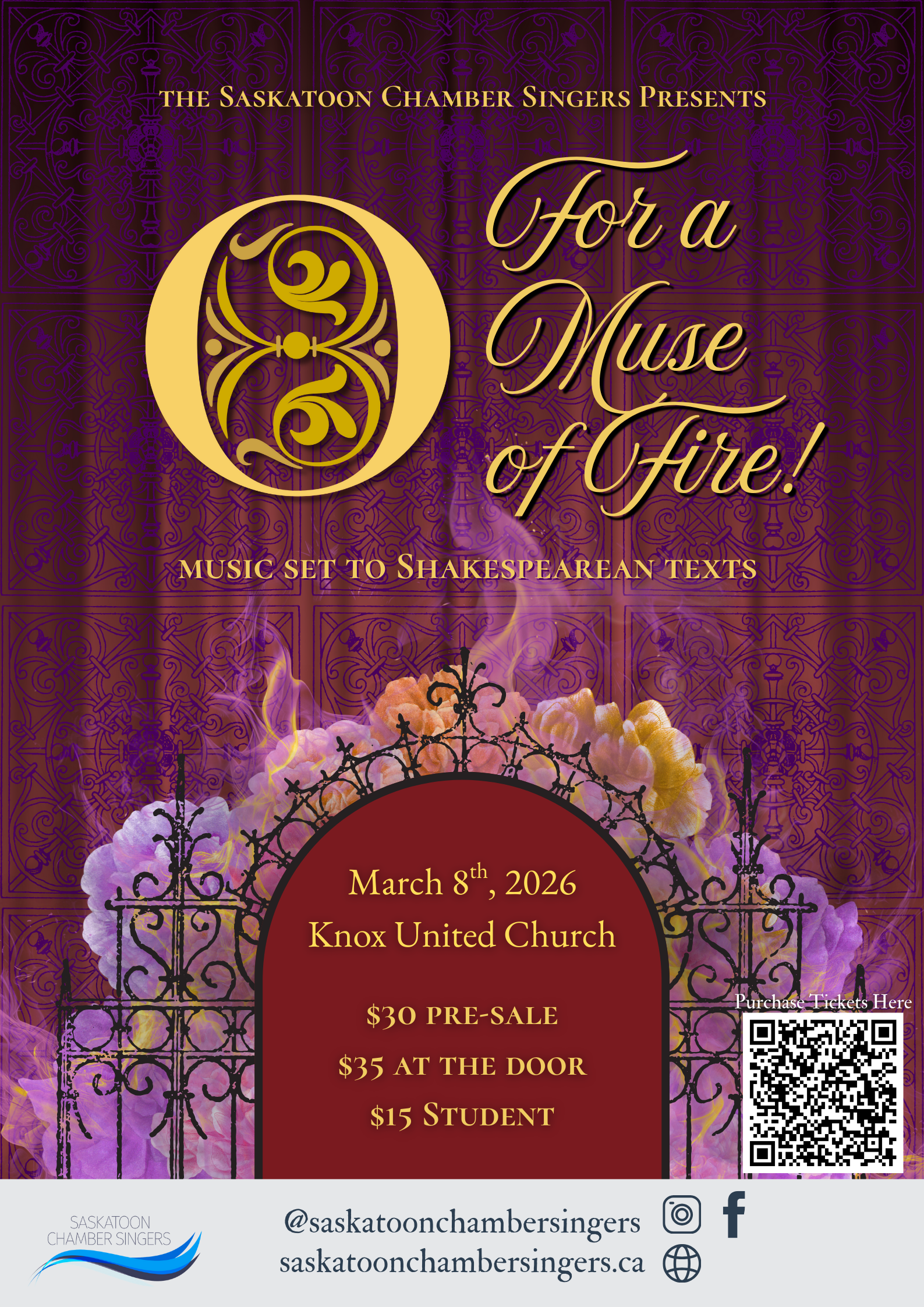
O, For a Muse of Fire!
Music set to Shakespearean Texts
Joined by Emmett Fortosky on Double Bass
and including
Sonnet performances by Philippa Williams and Hadleigh Vickers
Knox United Church
March 8th, 2026 | 3:00pm
$35 – General at the door
$15 – Students
Program Notes
This will be Saskatoon Chamber Singers’ third concert devoted to music set to the words of William Shakespeare. Songs were an integral part of many of Shakespeare’s plays and over the centuries many composers have taken those words and composed music for them. Some composers have taken other texts from Shakespeare’s plays and set them to music, although that was not Shakespeare’s initial intent. When Shakespeare’s plays are performed today there is almost always a composer on board who sets the song lyrics in those plays to music. So, literally hundreds of songs have been composed to the lyrics Shakespeare provided more than four hundred and fifty years ago. The songs in Shakespeare’s plays would have been sung by actors, not classical singers. As a result, Shakespeare’s lyrics are consequentially a lot simpler than his poetry and are often sprinkled with fun-to-sing nonsense words such as “hey, nonny, nonny.” As one would expect, most of those songs appear in his comedies and romances. Some of the pieces on this concert we have sung before, but there are several that are new to us as well. One is always amazed at the breadth and depth of Shakespeare’s texts.
James Hawn, Artistic Director
-
The opening piece, The Brightest Heaven, is one of those pieces not intentionally meant to be sung. The text comes from the opening lines of the prologue to Henry V:
“O, for a muse of fire that would ascend
The brightest heaven of invention!”
The composer, Daniel Elder, has added an extra line to each of Shakespeare’s lines to expand this monologue into a second dimension with the added perspective of introspection. In ancient Greek tradition, the Muses were the inspirational goddesses of the arts, literature, and science. They had specific names and disciplines, but none of them really covered the area of a history play, so the Chorus, in Henry V wishes for a “Muse of fire” to help. Elder says of his composition that the “muse” and “fire” “become incarnate objects to be addressed (‘O Fire, thou spark of life’ and ‘Illuminate, O Muse, thy soul’) thus giving this musical setting the ability of transitioning from external speech to internal thought. The Brightest Heaven balances these two functions and weaves them into one dramatic statement, set with piano accompaniment in a singularly orchestral style. In fact, the accompaniment may often be thought of as the fire itself, being blown into life and raging until its energies are spent and it wanes to remission.” -
O, Mistress Mine is from Act II, Scene 3 of Twelfth Night. Ralph Vaughan Williams set this text to music as part of Three Elizabethan Part Songs. This setting is simple and is over before you know it. Williams has composed a sprightly and light-hearted song with repeated use of triplets that enhances the jollity and merriment of the piece. Győrgy Orbán’s composition is more frivolous in nature with the tune predominantly in the soprano voice while the lower voices interject single syllables separated by rests. The “diridiridon” section imitates the laughter that comes with contemplating the mistress.
-
Juhani Komulainen, a Finnish composer, wrote a set of pieces entitled Four Ballads of Shakespeare. The first of these is To Be, Or Not To Be from Hamlet, Act III, Scene 1. Komulainen uses only the first few lines of the soliloquy as his text. The opening line of the soliloquy is first sung by the tenors, followed by the sopranos. This thematic phrase is repeated throughout while the tenors introduce another musical motif with the words:
“whether ‘tis nobler in the mind to suffer
The slings and arrows”
before the altos complete the line with:
“of outrageous fortune
Or to take arms against a sea of troubles.”
Then all the voices join to complete the piece on the words “that is the question.” -
Matthew Harris has set to music twenty-one of the lyrics of songs in Shakespeare’s plays. This concert will include six of those.
Take, O, Take Those Lips Away from Measure for Measure, Act IV, Scene 1 has traditionally been set to music as a slow lament, but Harris has given it a fast, driving fury of a lover scorned and that fury builds as the piece rushes to its conclusion. The song is sung by a boy to Mariana, lamenting false love with imagery of “forsworn” lips and misleading eyes that promise but betray.
Tell Me Where is Fancy Bred is from The Merchant of Venice, Act III, Scene 2. The song occurs while Bassanio is deciding which of the three caskets to choose so that Portia may become his bride. The lyrics suggest that “fancy” starts in the eyes and dies in the same place, hinting that the choice isn’t about grand, outward appearances but something more internal. As a result, Bassanio selects the lead casket rather than the gold or silver one. Harris’ composition is very much in the madrigal tradition.
Under The Greenwood Tree is taken from As You Like It, Act II, Scene 5. The song celebrates pastoral life as superior to courtly existence, inviting people to abandon ambition, wealth, and worries for the forest’s peace and simple joys. To capture the frolicsome, outdoor spirt of the text, Harris used the children’s tune Rain, Rain, Go Away.
Come Away, Come Away, Death is from Twelfth Night, Act II, Scene 4. This is also a song about unrequited love, but is dealt here “with resignation, as if an angelic chorus were singing an epilogue from above.” In the play, this song is sung by Feste (the Fool).
Hark, Hark! the Lark is from Act II, Scene 3 of Cymbeline. Harris originally wrote this piece for his own wedding. The music has “a dignified, processional character [apt] for the occasion”. The characters in the play are urged to wake up as dawn breaks because with the arrival of the dawn there will be new beginnings. The lark’s song symbolizes hope and the start of a new day, often associated with the sun god Phoebus.
Another Matthew Harris piece, and probably his most exuberant, is Where the Bee Sucks, There Suck I from Act V, Scene 1 of The Tempest. Ariel has been released from Prospero’s control and his joy at being free evokes the atmosphere of spring. Here man and nature have become one rather than man being dominant over nature. Shakespeare draws a parallel between sucking on a mother’s breast and the fertility, productivity, and regeneration of the bees and makes a connection of mankind by “there suck I.” Harris’ song is exceedingly rhythmic throughout and captures the joy and feeling of freedom of Ariel. Harris also makes wide use of dynamics, often separating forte and piano with a mere two notes.
-
Canadian composer Allan Bevan is one of many composers who have set Shakespeare’s song Full Fathom Five to music. The text is from The Tempest, Act I, Scene 2. In the play it is sung by Ariel, a spirit with magical powers who serves the magician Prospero. It is Ferdinand who hears this song and draws a parallel to his own father’s death by drowning. Bevan’s piece is filled with changes of mood and colour which are created with the help of the piano accompaniment. A fathom is about nine meters and “the father” who has drowned is gradually being absorbed and transformed by the sea, but “sea nymphs hourly ring his knell, ding, dong, knell.” Bevan writes so well for choir and this is very evident in this piece.
-
Jessica, daughter of Shylock, and Lorenzo have married, against her father’s will. Their love is strong and Lorenzo’s description of the night and the music of the spheres is one of Shakespeare’s great praises of music. These famous lines (How Sweet the Moonlight Sleeps) come from Act V, Scene 1 of The Merchant of Venice. Lorenzo expresses the serene beauty of a moonlit night where the moonlight is personified as sleeping, a human action, and sets a scene for quiet appreciation of nature and sound. Jared Tomlinson (Canadian) captures all that stillness and quiet in his gentle setting of these lyrics. The piece is homophonic throughout and the long notes make it easy to capture the feeling Shakespeare was painting with his words. We have to remember that the Globe Theatre had no lighting as our theatres do today, and so all of that had to be conveyed in the language that was being spoken.
-
Shakespeare wrote 154 sonnets and one of the most popular is Sonnet 18: Shall I Compare Thee to a Summer’s Day? Through rich harmonies sung a cappella, Lindberg has created a gentle and tender musical expression of this sonnet. The soprano voice always has the melodic line but the underlying harmonies by the three lower voices create a luscious accompaniment.
-
In the late 1980’s, George Shearing, with the help of William Shakespeare, composed a series of pieces for choir, jazz piano, and bass entitled Music to Hear. It was so well received by choirs and audiences alike that in 1999 a second set was published – Songs and Sonnets. There are seven pieces in this set.
Live With Me and Be My Love
This text was not actually written by Shakespeare but rather by the poet Christopher Marlowe who, in 1599, wrote the famous poem The Passionate Shepherd to His Love which has as its first line “Come live with me and be my love.” Marlowe was a contemporary of Shakespeare and somehow Shearing got the two confused. Except for the middle section, this piece is homophonic throughout. The middle section has the tenors and basses singing the text on a single note (B-natural) while the sopranos and altos harmonize on a “oo” over them. The tenors and basses then take up the original tune, followed by the altos and sopranos before all four parts end the piece.When Daffodils Begin to Peer from The Winter’s Tale, Act IV, Scene 2
This is a gently lilting selection with the soprano voice taking the melodic lead, sometimes with the lower parts accompanying them on an “oo.”It Was a Lover and His Lass from Act V, Scene 3 of As You Like It
Shearing has written a bouncy melody that is sung first by the sopranos and altos and then by the tenors and basses with the other voices joining in on the lines “In the spring time, the only pretty ring time, When birds do sing, hey ding-a-ding ding, Sweet lovers love the spring.”Spring from Love’s Labour’s Lost, Act V, Scene 2
Here the sopranos have the melody throughout while the lower voices, in five parts, accompany them with a complex harmonic “oo.”Who Is Sylvia? from Two Gentlemen of Verona, Act IV, Scene 2
This is one of the most beautiful settings one can listen to. It is sung slowly and expressively, a cappella, with a gentle pulsing piano part enhancing the overall effect.Fie on Sinful Fantasy from Act V, Scene 2 of The Merry Wives of Windsor
From the gentle tenderness of the previous movement, Shearing creates a rapid and forceful piece for unison voices with very rhythmic piano and double bass. After the fury of the beginning, the piece ends with a whimper.Hey, Ho, the Wind and the Rain from Twelfth Night, Act V, Scene 2
The last movement of the set features the tenors and basses who have the melodic line for the entire piece with the sopranos and altos coming in, almost as a commentary, during each verse. The set ends with a riff for piano and double bass.
-
At the end of A Midsummer Night’s Dream (Act V, Scene 1) Puck (Robin Goodfellow) steps forward and addresses the audience and offers an apology if what they have seen has offended, but he hopes instead that the actors will be applauded for what the audience has just seen. Puck is a mischievous fairy, sprite, or jester who has a significant influence over the events of the plot and who delights in playing pranks. If We Shadows Have Offended is sung almost as a chant that would take place in an Anglican service of worship. Midway through, the basses are given an extended solo over which the upper parts simply harmonize on “ah.” There is no bluster here and the piece ends quietly with Puck asking us, the audience, “to give me your hands” and “Robin shall restore amends.”
Text and Translations
Daniel Elder (B. 1986): The Brightest Heaven
From Henry V
O, for a muse of fire that would ascend
[O Fire, thou spark of life to humankind;]
The brightest heaven of invention!
[Illuminate, O Muse, thy soul to find!]
Ralph Vaughan Williams (1872-1958): O, Mistress Mine!
From Twelfth Night - Act II, Scene 3
O mistress mine, where are you roaming?
O stay and hear; your true love’s coming,
That can sing both high and low;
Trip no further, pretty sweeting;
Journeys end in lovers’ meeting,
Every wise man’s son doth know.
What is love? ’tis not hereafter;
Present mirth hath present laughter;
What’s to come is still unsure:
In delay there lies no plenty;
Then come kiss me, sweet and twenty;
Youth’s a stuff will not endure.
Juhani Komulainen (B. 1953): To Be, Or Not To Be
From Hamlet - Act 3, Scene 1
To be, or not to be, that is the question:
Whether ‘tis nobler in the mind, to suffer
The slings and arrows of outrageous fortune;
Or to take arms against a sea of troubles,
And by opposing end them?
Matthew Harris (B. 1956): Shakespeare Songs
Book II
Take, O, Take Those Lips Away – from Measure for Measure - Act IV, Scene 1
Take, oh take those lips away,
That so sweetly were forsworn,
And those eyes: the break of day,
Lights that do mislead the Morn;
But my kisses bring again, bring again,
Seals of love, but sealed in vain, sealed in vain.
Tell Me Where is Fancy Bred – from Merchant of Venice - Act III, Scene 2
Tell me where is Fancy bred,
Or in the heart or in the head?
How begot, how nourished?
Reply, reply.
It is engender'd in the eyes,
With gazing fed; and Fancy dies
In the cradle where it lies.
Let us all ring Fancy's knell:
I'll begin it,--Ding, dong, bell.
All. Ding, dong, bell.
Under the Greenwood Tree – from As You Like It - Act II, Scene 5
Under the Greenwood tree
Who loves to lie with me,
And turn his merry note
Unto the sweet bird's throat,
Come hither, come hither, come hither:
Here shall he see
No enemy
But winter and rough weather.
Who doth ambition shun,
And loves to live i' the sun,
Seeking the food he eats,
And pleas'd with what he gets,
Come hither, come hither, come hither:
Here shall he see
No enemy
But winter and rough weather.
Come Away, Come Away, Death – from Twelfth Night
Come away, come away, death,
And in sad cypress let me be laid.
Fly away, fly away, breath;
I am slain by a fair cruel maid.
My shroud of white, stuck all with yew,
O, prepare it!
My part of death, no one so true
Did share it.
Not a flower, not a flower sweet,
On my black coffin let there be strown.
Not a friend, not a friend greet
My poor corpse, where my bones shall be thrown.
A thousand thousand sighs to save,
Lay me, O, where
Sad true lover never find my grave,
To weep there!
Book I
Hark, Hark! the Lark – from Cymbeline
Hark! Hark! The lark at heaven’s gate sings,
And Phoebus ‘gins arise,
His steeds to water at those springs
On chalic’d flowers that lies’
And winking Mary-buds begin
To ope their golden eyes;
With everything that pretty is,
My lady sweet, arise:
Arise, arise!
Allan Bevan (B. 1951): Full Fathom Five
From The Tempest – Act I, Scene 2
Full fathom five thy father lies;
Of his bones are coral made;
Those are pearls that were his eyes:
Nothing of him that doth face,
But doth suffer a sea-change
Into something rich and strange.
Sea-nymphs hourly ring his knell:
Ding-dong.
Hark! Now I hear them, ding-dong, bell.
György Orbán (B. 1947): O, Mistress Mine!
From Twelfth Night – Act II, Scene 3
O mistress mine, where are you roaming?
O stay and hear; your true love’s coming,
That can sing both high and low;
Trip no further, pretty sweeting;
Journeys end in lovers’ meeting,
Every wise man’s son doth know.
What is love? ’tis not hereafter;
Present mirth hath present laughter;
What’s to come is still unsure:
In delay there lies no plenty;
Then come kiss me, sweet and twenty;
Youth’s a stuff will not endure.
Jared Tomlinson (B. 1990): How Sweet the Moonlight Sleeps
From The Merchant of Venice – Act V, Scene 1
How sweet the moonlight sleeps upon this bank!
Here will we sit and let the sounds of music
Creep in our ears: soft stillness and the night
Become the touches of sweet harmony.
Sit, Jessica. Look how the floor of heaven
Is thick inlaid with patines of bright gold:
There's not the smallest orb which thou behold'st
But in his motion like an angel sings,
Still quiring to the young-eyed cherubins;
Such harmony is in immortal souls;
But whilst this muddy vesture of decay
Doth grossly close it in, we cannot hear it.
Come, ho! and wake Diana with a hymn!
With sweetest touches pierce your mistress' ear,
And draw her home with music.
The reason is, your spirits are attentive:
For do but note a wild and wanton herd,
Or race of youthful and unhandled colts,
Fetching mad bounds, bellowing and neighing loud,
Which is the hot condition of their blood;
If they but hear perchance a trumpet sound,
Or any air of music touch their ears,
You shall perceive them make a mutual stand,
Their savage eyes turn'd to a modest gaze
By the sweet power of music: therefore the poet
Did feign that Orpheus drew trees, stones and floods;
Since nought so stockish, hard and full of rage,
But music for the time doth change his nature.
The man that hath no music in himself,
Nor is not moved with concord of sweet sounds,
Is fit for treasons, stratagems and spoils;
The motions of his spirit are dull as night
And his affections dark as Erebus:
Let no such man be trusted. Mark the music.
Matthew Harris (B. 1956): Shakespeare Songs
Book VI
Where the Bee Sucks, There Suck I – from The Tempest - Act V, Scene 1
Where the bee sucks, there suck I:
In a cowslip's bell I lie;
There I couch when owls do cry.
On the bat's back I do fly
After summer merrily.
Merrily, merrily shall I live now
Under the blossom that hangs on the bough.
Nils Lindberg (1933-2022): Shall I Compare Thee to a Summer’s Day
From O, Mistress Mine
Shall I compare thee to a summer’s day?
Thou art more lovely and more temperate:
Rough winds do shake the darling buds of May,
And summer’s lease hath all too short a date;
Sometime too hot the eye of heaven shines,
And often is his gold complexion dimm'd;
And every fair from fair sometime declines,
By chance or nature’s changing course untrimm'd;
But thy eternal summer shall not fade,
Nor lose possession of that fair thou ow’st;
Nor shall death brag thou wander’st in his shade,
When in eternal lines to time thou grow’st:
So long as men can breathe or eyes can see,
So long lives this, and this gives life to thee.
George Shearing (1919-2011): Songs and Sonnets From Shakespeare
1. Live with me and be my love
From Sonnets to Sundry Notes of Music, words by Christopher Marlowe
Come live with me and be my love,
And we will all the pleasures prove,
That Valleys, groves, hills, and fields,
Woods, or steepy mountain yields.
And we will sit upon the Rocks,
Seeing the Shepherds feed their flocks,
By shallow Rivers to whose falls
Melodious birds sing Madrigals.
And I will make thee beds of Roses
And a thousand fragrant posies,
A cap of flowers, and a kirtle
Embroidered all with leaves of Myrtle;
A gown made of the finest wool
Which from our pretty Lambs we pull;
Fair lined slippers for the cold,
With buckles of the purest gold;
A belt of straw and Ivy buds,
With Coral clasps and Amber studs:
And if these pleasures may thee move,
Come live with me, and be my love.
The Shepherds’ Swains shall dance and sing
For thy delight each May-morning:
If these delights thy mind may move,
Then live with me, and be my love.
2. When daffodils begin to peer
From The Winter’s Tale - Act IV, Scene 2
When daffodils begin to peer
With heigh! the doxy over the dale,
Why, then comes in the sweet o' the year;
For the red blood reigns in the winter's pale.
The white sheet bleaching on the hedge,
With heigh! the sweet birds, O, how they sing!
Doth set my pugging tooth on edge;
For a quart of ale is a dish for a king.
The lark, that tirra-lyra chants,
With heigh! with heigh! the thrush and the jay,
Are summer songs for me and my aunts,
While we lie tumbling in the hay.
3. It was a lover and his lass
From As You Like it - Act V, Scene 3
It was a lover and his lass
With a hey and a ho and a hey nonino,
That o'er the green cornfield did pass,
In springtime, the only pretty ring time,
When birds do sing, hey ding a ding, ding;
Sweet lovers love the spring.
Between the acres of the rye,
With a hey and a ho and a hey nonino,
These pretty country folks would lie,
In springtime, the only pretty ring time,
When birds do sing, hey ding a ding, ding;
Sweet lovers love the spring.
This carol they began that hour,
With a hey and a ho and a hey nonino,
How that life was but a flower
In springtime, the only pretty ring time,
When birds do sing, hey ding a ding, ding;
Sweet lovers love the spring.
4. Spring
From Love’s Labour’s Lost - Act V, Scene 2
When daisies pied and violets blue
And lady-smocks all silver-white
And cuckoo-buds of yellow hue
Do paint the meadows with delight,
The cuckoo then, on every tree,
Mocks married men; for thus sings he,
Cuckoo;
Cuckoo, cuckoo: O word of fear,
Unpleasing to a married ear!
When shepherds pipe on oaten straws,
And merry larks are ploughmen's clocks,
When turtles tread, and rooks, and daws,
And maidens bleach their summer smocks,
The cuckoo then, on every tree,
Mocks married men; for thus sings he,
Cuckoo;
Cuckoo, cuckoo: O word of fear,
Unpleasing to a married ear!
5. Who is Sylvia
From Two Gentlemen of Verona - Act IV, Scene 2
Who is Silvia? what is she,
That all our swains commend her?
Holy, fair and wise is she;
The heaven such grace did lend her,
That she might admired be.
Is she kind as she is fair?
For beauty lives with kindness.
Love doth to her eyes repair,
To help him of his blindness;
And, being help'd, inhabits there.
Then to Silvia let us sing,
That Silvia is excelling;
She excels each mortal thing
Upon the dull earth dwelling:
To her let us garlands bring.
6. Fie on sinful fantasy
From Two Gentlemen of Verona - Act IV, Scene 2
Fie on sinful fantasy!
Fie on lust and luxury!
Lust is but a bloody fire,
Kindled with unchaste desire,
Fed in heart, whose flames aspire
As thoughts do blow them, higher and higher.
Pinch him, fairies, mutually;
Pinch him for his villainy;
Pinch him, and burn him, and turn him about,
Till candles and starlight and moonshine be out.
7. Hey, ho, the wind and the rain
From Twelfth Night - Act V, Scene 2
When that I was and a little tiny boy,
With hey, ho, the wind and the rain,
A foolish thing was but a toy,
For the rain it raineth every day.
But when I came to man's estate,
With hey, ho, the wind and the rain,
'Gainst knaves and thieves men shut their gate,
For the rain it raineth every day.
But when I came at last to wive,
With hey, ho, the wind and the rain,
By swaggering could I never thrive,
For the rain it raineth every day.
But when I came unto my beds,
With hey, ho, the wind and the rain,
With toss-pots still had drunken head,s
For the rain it raineth every day.
A great while ago the world begun,
With hey, ho, the wind and the rain,
But that's all one, our play is done,
And we'll strive to please you every day.
Bernard Hughes (B. 1974): If We Shadows Have Offended
From A Midsummer Night’s Dream – Act V, Scene 1
If we shadows have offended,
Think but this, and all is mended,
That you have but slumbered here
While these visions did appear.
And this weak and idle theme,
No more yielding but a dream,
Gentles, do not reprehend:
If you pardon, we will mend:
And, as I am an honest Puck,
If we have unearned luck
Now to ‘scape the serpent’s tongue,
We will make amends ere long;
Else the Puck a liar call;
So, good night unto you all.
Give me your hands, if we be friends,
And Robin shall restore amends.
Artist Information
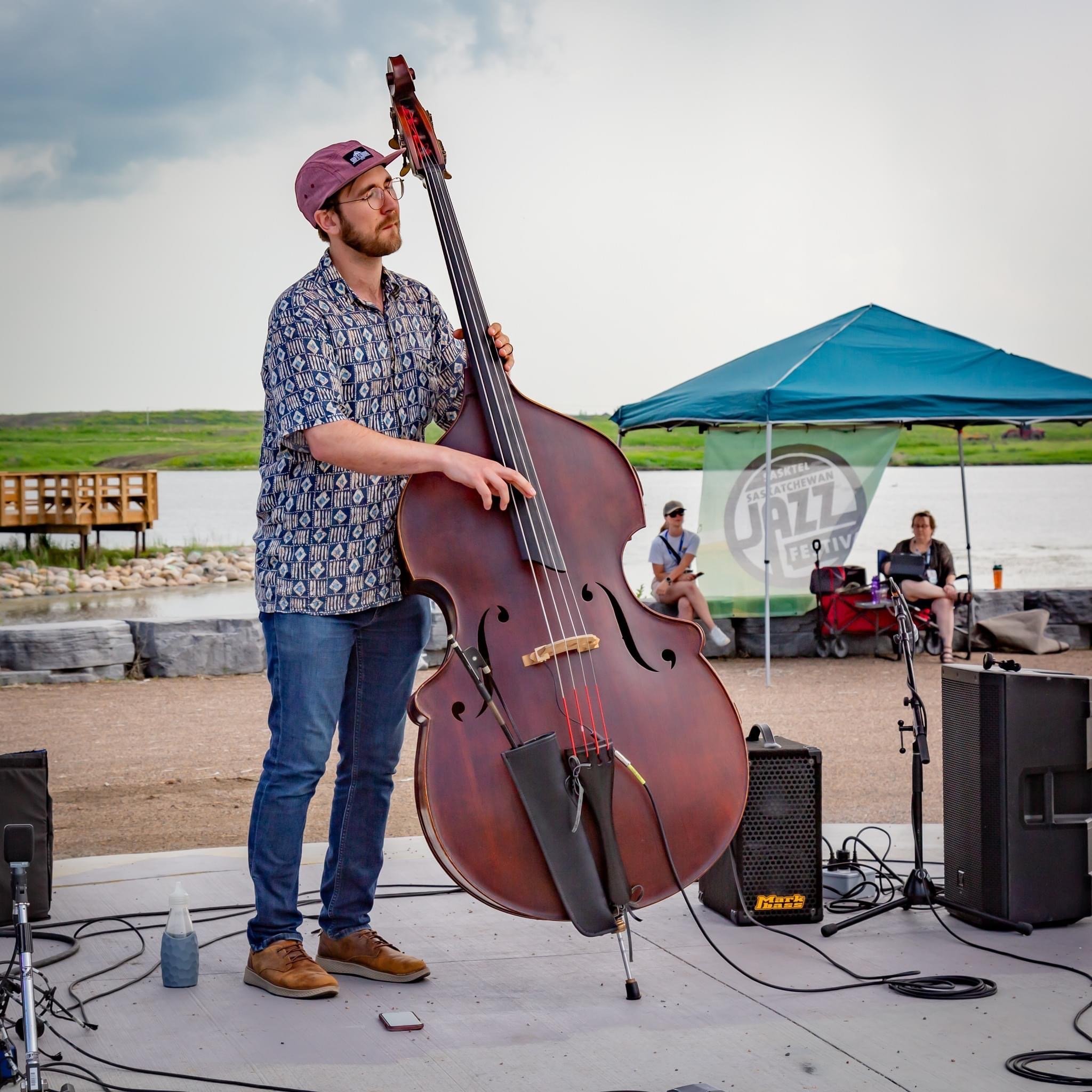
Emmett Fortosky, Double Bass
-
Emmett Fortosky is a professional bassist and educator based in Saskatoon, Saskatchewan. Emmett has received a Bachelor of Music (Mus. Ed) Honours, Bachelor of Education and a Jazz Certificate from the University of Saskatchewan. In addition, he spent time studying at Humber College in Toronto where he learned from prominent Canadian bassists Neil Swainson and Mike Downes. Priding himself on playing a variety of types of music, Emmett has performed with a selection of musicians from across many genres. Notably, he has performed in The Eagles Orchestra, Caity Gyorgy, Larnell Lewis (with the SJO), The Saskatoon Symphony Orchestra (sharing the stage with Tanya Tagaq) and has opened for Boney M. with Ellen Froese. Ongoing projects include groups such as Sons of Django, which is set to release its debut album in 2026. His passion for music is maintained both on and off the stage as he is also heavily involved in instructing music. In his role as a music educator, Emmett teaches elementary school Band, hosts the Bassment Jazz Jam Series and gives private lessons and clinics. Emmett also created an educational initiative called, “Jazz in the Schools Saskatchewan (JSSK),” to continue building the jazz scene in his home province.
James Hawn, Director

Photo Credit: Amy Violet Photography
-
James Hawn, Director of Music since 2003, has been active with the Saskatoon Chamber Singers for most of its history, and has been involved with singing and choirs for as long he can remember. Prior to his current appointment as Director, he was a long-time member of the bass section, and served as the choir’s president for ten years. James has also been actively involved in national and provincial choral organizations for over twenty-five years. He is a member of the Saskatchewan Choral Federation (SCF) and Choral Canada and has served for a number of years on both organizations’ boards. In 2006 he was presented with the SCF’s Pro Musica Award, which recognizes “exemplary service to choral music in Saskatchewan.” James was an English language arts teacher for thirty- two years with the Saskatoon Public Board of Education. During that time he also taught music, was involved in choral and church music, musicals, and drama both in the school system and in the community.
Connor Elias, Collaborative Pianist

Photo Credit: Rebecca Fisher
-
Connor Elias is a pianist from Martensville, Saskatchewan. He holds a Bachelor of Music Honours from the University of Saskatchewan, as well as an ARCT in Piano Performance from the Royal Conservatory of Music. Connor has many influences and include his teacher Bonnie Nicholson. Throughout his undergrad, Connor has received various accolades at provincial and national music festivals, including second in the 2023 Saskatchewan Concerto Competition and third in the 2022 Canada West for piano solo. Apart from piano, Connor is involved as a chorister in the Greystone Singers, conducted by Dr. Jennifer Lang. He enjoys teaching his wonderful piano students, laughing with friends, and spending time with his family.