

Knox United Church
December 13th, 2026 | 2:00pm and 7:30pm
$35 – General at the door
$15 – Students
Program Notes
As Saskatchewan folks, we have definitely experienced winter and all that it can bring. To some it is an enjoyable season, while to others it is a time to get away to warmer climes. Whatever your attitude towards winter is, you will have experienced all the descriptions that are contained in the selections for this concert. Winter offers us snow and snowflakes, frost, ice and icicles, cold, wind, blizzards, white-outs, and of course, for many people, Christmas and Christmas holidays. For some, winter offers the pleasures of skiing, tobogganing, skating, sleigh riding and snowball fighting. Since winter is so much a part of Canadian life, it is not surprising that all but two of the pieces on this concert have been composed by Canadians. Enjoy the concert! Perhaps bring a blanket along or wear a sweater just in case you start to experience some of those effects of winter!
James Hawn, Artistic Director
-
David K. MacIntyre, who is from Yorkton, SK, is no stranger to winter weather although he now lives in more temperate Vancouver. He was commissioned to write a piece for the Whitehorse Community Choirs and chose to set to music words by Clea Roberts. The five sections of this piece just about encapsulate all that winter can do to a person. Cold Snap (a phrase not unfamiliar here on the prairies) is in several sections with each section highlighting an effect that cold weather can have on a person. Often humorous, the music makes true the text “I want to be a winter person, I like the way it implies improvement.” Here the cold flattens the tires and makes them square and slows one’s lips and eyelids.
-
The text for John Rutter’s Blow, Blow, Thou Winter Wind is from Shakespeare’s As You Like It and is a bittersweet song sung by Amiens, a follower of the exiled Duke Senior who is now living a Robin Hood-like life in the Forest of Arden after having been robbed of his rightful dukedom by the usurping brother. There is despair but also optimism for what might lie ahead. The piece opens with the soprano section singing about the unkind winter wind. They are then joined by the entire choir who change the mood from the bleakness of winter to “Heigh, ho! Sing unto the green holly, this life is most jolly.” The opening phrase is then sung by the tenors and basses, accompanied by the upper voices vocalizing an “ah” sound. The piece ends with all the voices singing the “Heigh, ho!” refrain.
-
Robert Frost’s poem Stopping By Woods on a Snowy Evening has been set to music by many composers. This concert will feature two different versions of the text. Larry Nickel’s Miles to Go Before I Sleep is a gentle rendering of the poem with a piano accompaniment that creates the quiet and stillness of the night as a rider and his horse make the long journey home because there are “promises to keep.” The sopranos and altos begin and are then echoed by the tenors and basses before all the voices sing together. There is a slight feeling of foreboding, but overall the mood is one of solemnity and languor as the rider reflects on the “dark and deep” woods.
-
Cold is the Night by Stephanie Martin is one section of the cantata Winter Nights. The piece sets to music four winter proverbs. They are “Cold is the night when stars shine bright” followed by “Red sky at night sailor’s delight.” Next are “When the wind is out of the east, ‘tis neither good for man nor beast” and “When sound travels wide a stormy day will betide.” There is an icy feel to this piece which uses the first proverb as a refrain so as to emphasize the coldness of the winter night.
-
Snow by Ben Bolden is the second piece set to Robert Frost’s poem mentioned above. This piece was the winner of the 2022 Da Capo Chamber Choir Choral Composition Competition. The upper voices set the mood before the tenors and the basses, followed by the sopranos, sing the words of the poem. The second section features interplay between the four voices. Bolden’s use of eighth notes emphasizes the monotony of the journey but also reinforces the beauty of the landscape when the dynamics of the piece finally reach fortissimo. This immediately changes back to the quiet quality as the rider settles in for the long journey ahead of him and the anticipation of much needed sleep.
-
Gerard Weber, alto saxophone
Another Canadian composer, Zachary Wadsworth, has taken Henry Wadsworth Longfellow’s poem Snowflakes and set it to music for choir, piano, and alto saxophone. This piece was originally written for the TTBB choir Chor Leoni. The piece opens with the saxophone, accompanied by piano, as they create the mood for what is to come. When the choir enters it continues this mood of eerie quietness as “soft and silent descends the snow.” All the while the piano is playing undulating triplets in the right hand. The piano and saxophone act as a bridge between the choral parts. The second choral section is more agitated and filled with motion and creates an ominous feeling that hints at the grief the troubled sky may reveal. Following another interlude, the choir re-enters with the same music as they began with. The text here is “This is the poem of the air, slowly in silent syllables recorded; This is the secret of despair, long in its cloudy bosom now revealed.” The piece ends with the choir vocalizing on an “mm,” but the harmonies have a rather unsettling quality.
-
Kathleen Allan chose to set to music Canadian poet Archibald Lampman’s poem The Frost. This is a beautiful piece that sees the beauty in the frost as it lingers in the air or attaches itself to windows, but that also “stings like fire upon my cheek.” The poem looks at the effect the fog has on the stars, the moon, the snow, and the view around. Allan often highlights one voice or two voices in harmony while the others help to create the silence that seems present in so many poems about winter. At one point the tenors exclaim in triplets “Oh, oh” as though surprised or awed by the stars that appear “like jets of silver from a violet dome” because there is “beauty everywhere.”
-
Ann Salmon, flute
Lady Icicle (a poem by E. Pauline Johnson) has been set to music by Jeff Smallman. It is for female voices, piano, and flute. There is a mysteriousness about this piece which makes it almost ethereal. There are long flowing lines, gentle harmonies, and interesting vocal parts for each of the three voices. For the most part all three voices sing together with the time signatures alternating between three four time and six eight time with a few bars of seven eight time just for good measure.
-
Ice by Bruce Sled “evokes a landscape of wind, drifting snow, cold wind, and the crackling and melting of ice on a winter lake.” The female voices sing undulating lines on syllables “ahh, ah, ha, and da” which move in and out of dissonance while the male voices (at first) create the sounds of winter. As the piece progresses the female voices drop out one by one and join the lower voices in creating the sounds until only one voice is left on each of the female vocal lines.
-
Christina Rosetti’s poem In the Bleak Midwinter is another poem that has been set to music by many composers. In this version, Dan Forrest takes the familiar 1906 Gustav Holst tune and makes his own arrangement of it. We are transported into Rosetti’s text which was written in London around 1872. (Listen for the subtle hint of Big Ben.) Ethereal melodic echoes eventually build to soaring vocal lines before giving way to a tender final stanza – “What can I give him, poor as I am?” This is an intimate and deeply moving arrangement. Forrest cleverly writes the piece in twelve eight, but within some bars the triplets become duples.
-
I have resisted including The Huron Carol in concerts over the past years because so many see the carol “as reeking of rapacious colonialism and inherent racism.” The Huron had their own religion and no one asked a French priest to come along and change that. It was originally sung in the Huron language and attributed to Jean de Brefeuf. Wyandot’s Realm is a re-interpretation of that carol by Cree composer Andrew Balfour, who comes from Winnipeg. In this version, sections of the choir intone “Manitou, Manitou” in much the same manner of a drum and this continues as the well-known carol tune is sung in the Huron/Wyandot language. It was originally known as Jesous Ahatonia. This may well be the only version composed by an Indigenous composer. Balfour writes, “Wyandot is the accurate name of the great First Nation tribe of Eastern Canada that the French called the Huron, a title that the Wyandot people felt was derogatory. The Wyandot were one of the greatest of the Northern American First Nations, numbering in the hundreds of thousands. They had an Empire that spanned most of what is now Quebec and the Eastern part of the U.S. The Wyandot are an Indigenous people of the Northeastern Woodlands of present-day United States and Canada. Their Wyandot language belongs to the Iroquoian language family. In Canada, the Huron-Wendat Nation has two First Nations reserves at Wendat, Quebec.”
-
Trent Worthington has chosen three winter poems by Sara Teasdale (1884-1933) to comprise his set of Three Winter Songs. The first piece, A Winter Bluejay is elegantly set to music and includes a challenging piano part. Mostly homophonic at first, the text and the music pave the way for the appearance of the bluejay. The motion of skaters on the lake is done by having the altos sing a winding melody which is accompanied by an oom-pah-pah effect in the other parts. Worthington paints wonderful pictures of winter and the ecstasy one experiences at what one sees – “In ecstasy we laughed, drinking wine of love.” Was it not music that sounded the highest note? No, it was the bluejay who “fearless as our love…cocked his crest! Oh, who can tell the range of joy!” The second piece, A Winter Night, is sung a cappella and is homophonic throughout and has much the same musical effect as Stephanie Martin’s Cold Is the Night. All the harshness of winter is depicted but all at once the full choir singing high in their ranges explodes on the words “to smite.” The phrase “My window pane is starred with frost, the world is bitter cold tonight” serves as a connection between the various parts of this piece. There is an icy coldness to Worthington’s writing. The last piece in the set is Snow Song. It begins in contrast to the previous two pieces and “sparkles like snowflakes” throughout. The speaker of the poem wishes to be able to fly like the blowing snow or drift like a star to “my dear” which happens, but once there she “dies on his lips that are warm.” So, the joyfulness at the beginning has faded as the piece ends.
Text and Translations
🇨🇦 David K. MacIntyre (b. 1952): Cold Snap
The simple argument of birds retract into the forest.
The house settles in the hungry air, its short complaints
Plucking and clapping.
Frost pools and grows on the bedroom window.
This is the landscape of our dreaming.
The bright boughs we breath out in our sleep.
The narrow light of morning;
The wavering syllables of the radio indigenous to the kitchen,
Where you fry bacon and the rising bread smelling of yeast or nostalgia.
Let’s be an old couple some day.
The visible and the invisible economies drifting between us.
May be it’s heart palpitations,
May be it’s a snow plow scraping the chip seal road.
You are the only audience to my frailty.
I want to be a winter person; I like the way it implies improvement.
So cold it squared the truck’s wheels and unstitched the long sleeve of our schedules,
The sound of distant highways folded then placed in the doorstep.
Tell me how to breathe between what is painful and what is beautiful,
My lips, my eye lids slow with cold.
John Rutter (b. 1945): Blow, Blow, Thou Winter Wind
Text by William Shakespeare (1564-1616) from “As You Like It”
Blow, blow thou winter wind
Thou art not so unkind
As man's ingratitude;
Thy tooth is not so keen
Because thou art not seen
Although thy breath be rude
Heigh ho! sing heigh ho! unto the green holly:
Most friendship is feigning, most loving mere folly:
Then, heigh ho! the holly!
This life is most jolly
Freeze, freeze thou bitter sky
Thou dost not bite so nigh
As benefits forgot:
Though thou the waters warp
Thy sting is not so sharp
As friend remember'd not”
Heigh ho! sing heigh ho! unto the green holly:
Most friendship is feigning, most loving mere folly:
Then, heigh ho! the holly!
This life is most jolly.
🇨🇦 Larry Nickel (b. 1952): Miles to Go Before I Sleep
Text by Robert Frost (1874-1963) — Stopping by Woods on a Snowy Evening
Whose woods these are I think I know.
His house is in the village though;
He will not see me stopping here
To watch his woods fill up with snow.
My little horse must think it queer
To stop without a farmhouse near
Between the woods and frozen lake
The darkest evening of the year.
He gives his harness bells a shake
To ask if there is some mistake.
The only other sound's the sweep
Of easy wind and downy flake.
The woods are lovely, dark and deep,
But I have promises to keep,
And miles to go before I sleep,
And miles to go before I sleep.
🇨🇦 Stephanie Martin (b. 1962): Cold Is the Night
Winter Proverbs
Cold is the night when stars shine bright.
Red sky at night sailor’s delight.
When the wind is out of the East ‘tis neither good for man nor beast.
When sounds travel wide a stormy day will betide.
Cold is the night when stars shine bright.
🇨🇦 Ben Bolden (b. 1971): Snow
Text by Robert Frost (1874-1963) — Stopping by Woods on a Snowy Evening
Whose woods these are I think I know.
His house is in the village though;
He will not see me stopping here
To watch his woods fill up with snow.
My little horse must think it queer
To stop without a farmhouse near
Between the woods and frozen lake
The darkest evening of the year.
He gives his harness bells a shake
To ask if there is some mistake.
The only other sound's the sweep
Of easy wind and downy flake.
The woods are lovely, dark and deep,
But I have promises to keep,
And miles to go before I sleep,
And miles to go before I sleep.
🇨🇦 Zachary Wadsworth (b. 1983): Snowflakes
Poem by Henry Wadsworth Longfellow (1807-1882)
Out of the bosom of the Air,
Out of the cloud-folds of her garments shaken,
Over the woodlands brown and bare,
Over the harvest-fields forsaken,
Silent, and soft, and slow
Descends the snow.
Even as our cloudy fancies take
Suddenly shape in some divine expression,
Even as the troubled heart doth make
In the white countenance confession,
The troubled sky reveals
The grief it feels.
This is the poem of the air,
Slowly in silent syllables recorded;
This is the secret of despair,
Long in its cloudy bosom hoarded,
Now whispered and revealed
To wood and field.
🇨🇦 Kathleen Allan (b. 1989): The Frost
Poem by Archibald Lampman (1861-1899) — Winter Uplands
The frost that stings like fire upon my cheek,
The loneliness of this forsaken ground,
The long white drift upon whose powdered peak
I sit in the great silence as one bound;
The rippled sheet of snow where the wind blew
Across the open fields for miles ahead;
The far-off city towered and roofed in blue
A tender line upon the western red;
The stars that singly, then in flocks appear,
Like jets of silver from the violet dome,
So wonderful, so many and so near,
And then the golden moon to light me home—
The crunching snowshoes and the stinging air,
And silence, frost, and beauty everywhere.
🇨🇦 Jeff Smallman (b. 1965): Lady Icicle
Poem by Emily Pauline (Tekahionwake) Johnson (1861-1913)
Little Lady Icicle is dreaming in the north-land
And gleaming in the north-land, her pillow all a-glow;
For the frost has come and found her
With an ermine robe around her
Where little Lady Icicle lies dreaming in the snow.
Little Lady Icicle is waking in the north-land,
And shaking in the north-land her pillow to and fro;
And the hurricane a-skirling
Sends the feathers all a-whirling
Where little Lady Icicle is waking in the snow.
Little Lady Icicle is laughing in the north-land,
And quaffing in the north-land her wines that overflow;
All the lakes and rivers crusting
That her finger-tips are dusting,
Where little Lady Icicle is laughing in the snow.
Little Lady Icicle is singing in the north-land,
And bringing from the north-land a music wild and low;
And the fairies watch and listen
Where her silver slippers glisten,
As little Lady Icicle goes singing through the snow.
Little Lady Icicle is coming from the north-land,
Benumbing all the north-land where'er her feet may go;
With a fringe of frost before her
And a crystal garment o'er her,
Little Lady Icicle is coming with the snow.
Gustav Holst (1874-1934 [Arr. Dan Forrest (b. 1978)]: In the Bleak Midwinter
Poem by Christina Rossetti (1830-1894)
In the bleak midwinter, frosty wind made moan,
Earth stood hard as iron, water like a stone;
Snow had fallen, snow on snow, snow on snow,
In the bleak midwinter, long ago.
Our God, Heaven cannot hold Him, nor earth sustain;
Heaven and earth shall flee away when He comes to reign.
In the bleak midwinter a stable place sufficed
The Lord God Almighty, Jesus Christ.
Enough for Him, whom cherubim, worship night and day,
Breastful of milk, and a mangerful of hay;
Enough for Him, whom angels fall before,
The ox and ass and camel which adore.
Angels and archangels may have gathered there,
Cherubim and seraphim thronged the air;
But His mother only, in her maiden bliss,
Worshipped the beloved with a kiss.
What can I give Him, poor as I am?
If I were a shepherd, I would bring a lamb;
If I were a Wise Man, I would do my part;
Yet what I can I give Him: give my heart.
🇨🇦 Trad. Huron Carol [Arr. Andrew Balfour (b. 1967)]: Wyandot’s Realm
Manitou, Manitou
(Mysterious being.)
Wyandot
(tribe)
Deo!
(God!)
Ehstennyahyan deh tsonweh Eesus a hatonnyah
(Have courage, you who are humans. Jesus, he is born)
On nahwah teh wahdokee nonwah dah ska waen tak.
(Behold, the spirit who had us as prisoners, domestic animals, has fled.)
En nonshyen skwah tree hotat Nonwakneeyon rahshat torah
(Do not listen to it, as it corrupts our minds, the spirit of our thoughts.)
Eesus ahatonnyah. In excelsis Gloria!
(Jesus is born. Glory in the highest!)
🇨🇦 Trent Worthington (b. 1963): Three Winter Songs
Poems by Sara Teasdale (1884-1933)
A Winter Bluejay
Crisply the bright snow whispered,
Crunching beneath our feet;
Behind us as we walked along the parkway,
Our shadows danced,
Fantastic shapes in vivid blue.
Across the lake the skaters
Flew to and fro,
With sharp turns weaving
A frail invisible net.
In ecstasy the earth
Drank the silver sunlight;
In ecstasy the skaters
Drank the wine of speed;
In ecstasy we laughed
Drinking the wine of love.
Had not the music of our joy
Sounded its highest note?
But no,
For suddenly, with lifted eyes you said,
“Oh look!”
There, on the black bough of a snow flecked maple,
Fearless and gay as our love,
A bluejay cocked his crest!
Oh who can tell the range of joy
Or set the bounds of beauty?
A Winter Night
My window-pane is starred with frost,
The world is bitter cold to-night,
The moon is cruel, and the wind
Is like a two-edged sword to smite.
God pity all the homeless ones,
The beggars pacing to and fro,
God pity all the poor to-night
Who walk the lamp-lit streets of snow.
My room is like a bit of June,
Warm and close-curtained fold on fold,
But somewhere, like a homeless child,
My heart is crying in the cold.
Snow Song
Fairy snow, fairy snow,
Blowing, blowing everywhere,
Would that I
Too, could fly
Lightly, lightly through the air.
Like a wee, crystal star
I should drift, I should blow
Near, more near,
To my dear
Where he comes through the snow.
I should fly to my love
Like a flake in the storm,
I should die,
I should die,
On his lips that are warm.
Artist Information
Gerard Weber, Alto Saxophone
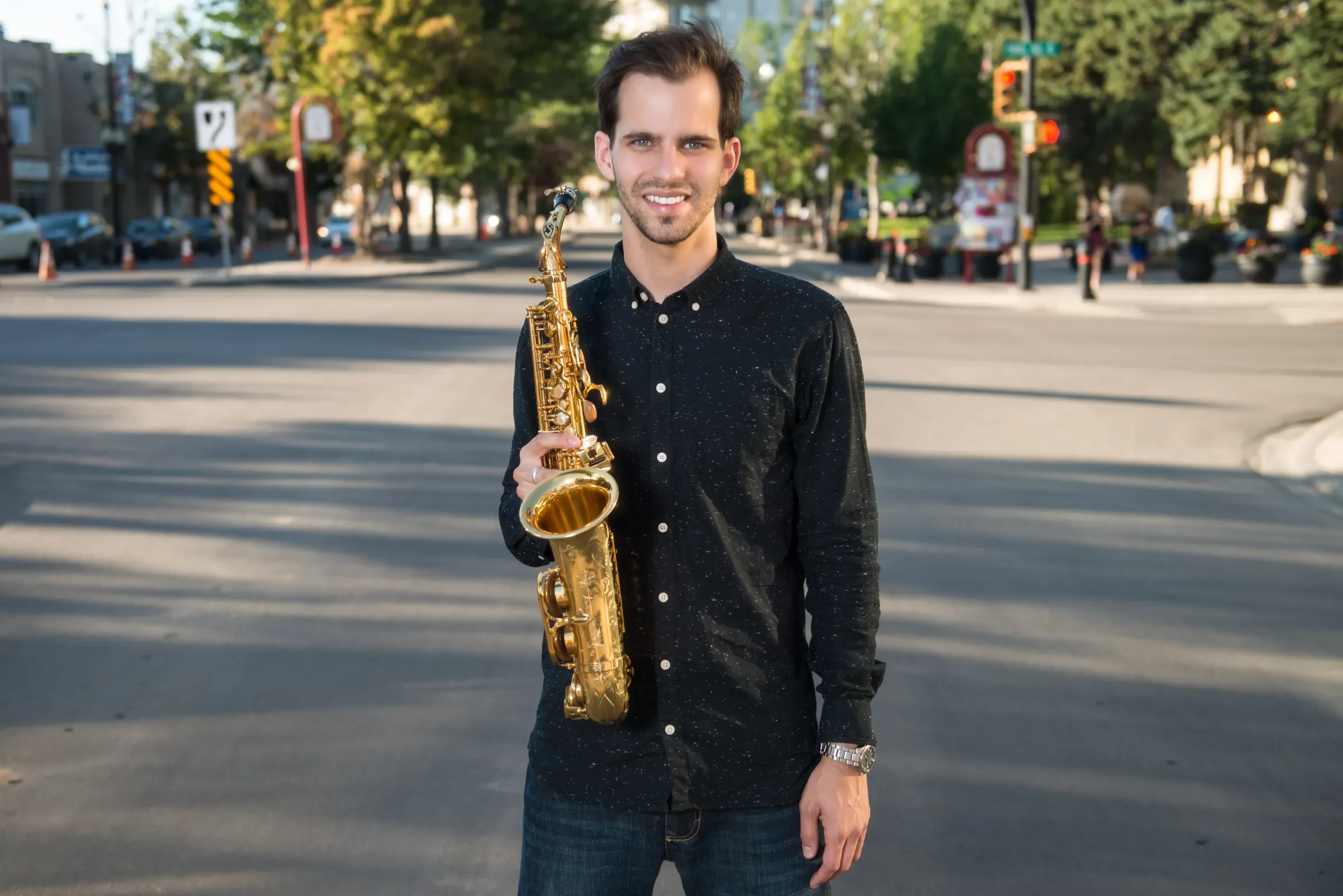
Photo Credit: Matt Luciuk
-
Gerard Weber has performed as a soloist and chamber musician in Canada, the United States, Germany, Switzerland, and the Netherlands. A few highlights of Gerard’s musical achievements include the first place winner of the woodwind category at the 2012 National Music Festival Competition of Canada, winner of the 2013 Shurniak Concerto Competition, and winner of the 47th Annual University of Florida Concerto Competition. Gerard has been featured as a soloist with the Regina Symphony Orchestra, the Saskatoon Symphony Orchestra, the University of Saskatchewan Wind Orchestra, and the University of Florida Orchestra, Wind Symphony, and University Chorus. He was a featured soloist at the 2013 World Music Contest held in Kerkrade, Netherlands, with the University of Saskatchewan Wind Orchestra. Gerard was also awarded the University of Saskatchewan Film Society Prize for the most outstanding fine arts graduate for 2013 Spring Convocation.
As a member of the North American Saxophone Alliance, Gerard performed in the 2013, 2017, and 2019 Region IX Conferences, the 2014, 2016, and 2018 Biennial Conferences, and the 2015 Region XI Conference. Musicological presentations include a research project on the incorporation of classical and Medieval rhetoric as performance practice for saxophonists (NASA 2013 Region IX Conference) and an overview and interpretation of the musical instrument innovations of Adolphe Sax (Adolphe Sax 2014 Bicentennial Celebration, University of Florida). Gerard’s research interests include the Song of Songs biblical text and its intersection with music, Medieval and Renaissance rhetoric, notation, performance, and analysis, as well as 20th-century music and aesthetics. Gerard was recently invited to submit a paper to a volume specifically celebrating the life and compositions of Canadian composer Murray Adaskin, titled “The Vision of Murray Adaskin (1906-2002): His Contributions to the Musical Scene of Canada and Beyond” (edited by Eli Bornstein, Sheila Kreyszig, and Walter Kreyszig, publication forthcoming). The title of Gerard’s contribution is “A ‘Distinctly Canadian’ Composer: Personification and Self-Identification in the Woodwind Quintets of Murray Adaskin (Victoria, British Columbia, 1974 & 1993; Adaskin Nos. 21 & 22).”
Gerard received his Bachelor of Music Honours degree from the University of Saskatchewan and earned the Master of Music degree from the University of Florida. Gerard was accepted to the Ph.D. in Musicology program at The University of Western Ontario and will begin studies in the fall of 2020. Gerard’s influential teachers and mentors include Dr. James Grier, Dr. Jonathan Helton, Dr. Jennifer Thomas, Dr. Glen Gillis, Dr. Walter Kreyszig, Troy Linsley, Stephanie Balon, and Kimberly Drury.
Gerard is currently based in Saskatoon as a performer and educator. In Saskatoon, Gerard has been involved with a number of musical organizations and events, including the Fireside Singers’ productions of Les Misérables and The Wizard of Oz, The Saskatoon Symphony Orchestra, the Saskatoon Jazz Orchestra, the North Saskatchewan Wind Symphony, the Strata New Music Festival, and the SaskTel Saskatchewan Jazz Festival. Gerard’s most recent project, the Gerard Weber Group, focuses on the music of jazz guitarist Pat Metheny and original works inspired by electronic manipulation of acoustic instruments (Please visit the Listen page to hear other recent musical projects).
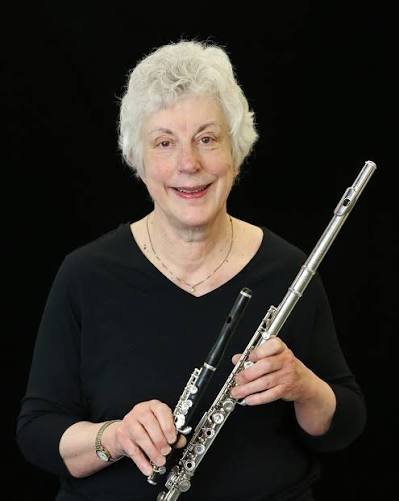
Ann Salmon, Flute
-
Ann has a B.Sci. degree in flute and vocal performance, and music education. After teaching elementary music, she moved to New York City to play flute professionally before being accepted into the M.Div program at Yale Divinity School and the Yale Institute of Sacred Music. Ann is an ordained Lutheran pastor and has always considered music to be an essential part of her ministry. She moved to Canada in 2008 to develop an Anglican/Lutheran shared ministry. Ann received a Doctor of Ministry degree in 2017 and began teaching at the Lutheran Theological Seminary, Saskatoon that same year. Besides gathering often with friends to play music and sing, Ann also plays flute and piccolo in community bands in Saskatoon and sings with the Saskatoon Chamber Singers.
James Hawn, Director

Photo Credit: Amy Violet Photography
-
James Hawn, Director of Music since 2003, has been active with the Saskatoon Chamber Singers for most of its history, and has been involved with singing and choirs for as long he can remember. Prior to his current appointment as Director, he was a long-time member of the bass section, and served as the choir’s president for ten years. James has also been actively involved in national and provincial choral organizations for over twenty-five years. He is a member of the Saskatchewan Choral Federation (SCF) and Choral Canada and has served for a number of years on both organizations’ boards. In 2006 he was presented with the SCF’s Pro Musica Award, which recognizes “exemplary service to choral music in Saskatchewan.” James was an English language arts teacher for thirty- two years with the Saskatoon Public Board of Education. During that time he also taught music, was involved in choral and church music, musicals, and drama both in the school system and in the community.
Connor Elias, Collaborative Pianist

Photo Credit: Rebecca Fisher
-
Connor Elias is a pianist from Martensville, Saskatchewan. He holds degrees in Music Education and Piano from the University of Saskatchewan, as well as an ARCT in Piano Performance from the Royal Conservatory of Music. Connor is grateful for his influences, including his teacher, Bonnie Nicholson. He is the recipient of many local, provincial, and national accolades for piano. Connor is an elementary music teacher in Saskatoon.